Grades
Best for grades 2-5, with read-aloud support for younger or mixed reading levels.
Free Chinese mythology lesson plan
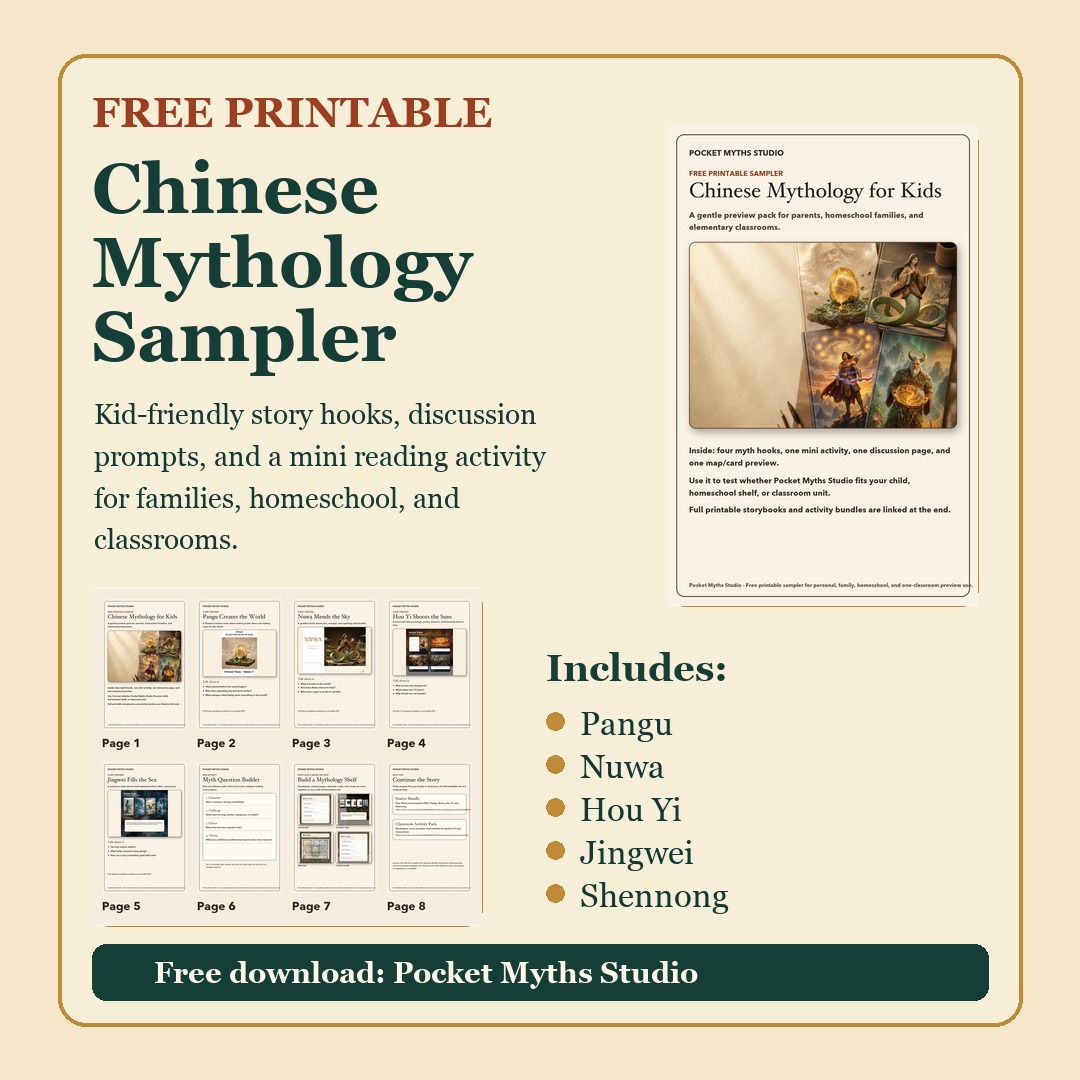
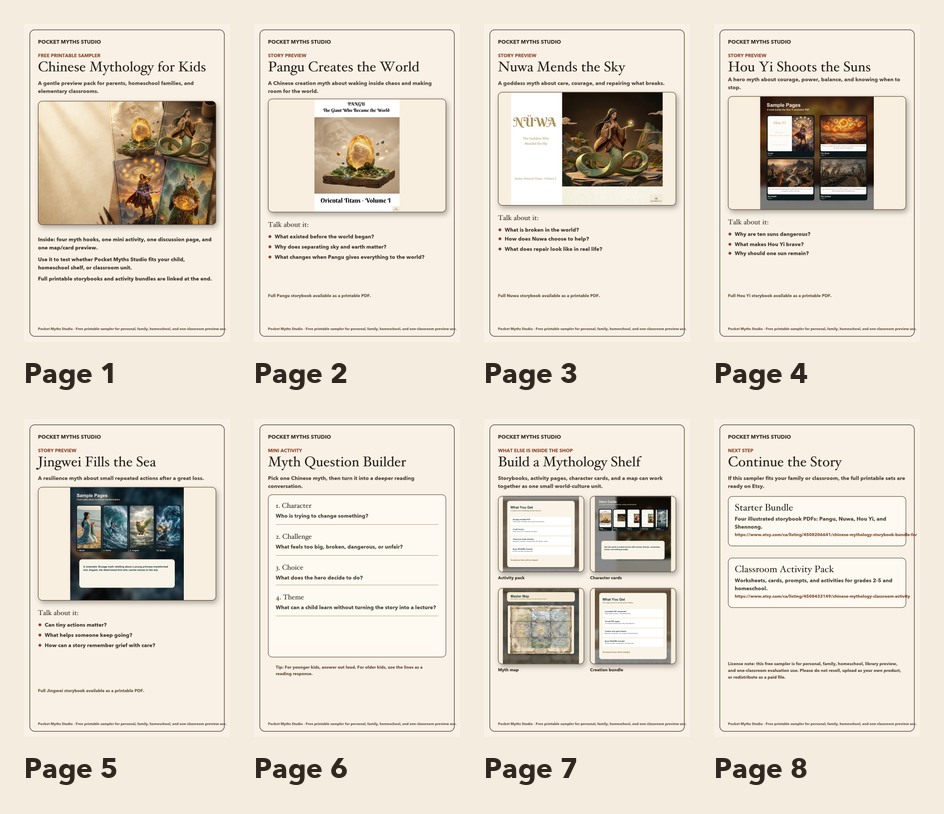
Introduce Pangu, Nuwa, Hou Yi, Jingwei, and Shennong with a low-prep lesson flow, discussion prompts, and a free printable sampler.
Lesson Objective
This mini-unit works as a mythology warmup, world-culture lesson, substitute plan, or first day of a longer folktales unit. It is intentionally short enough to run from a printable preview.
Best for grades 2-5, with read-aloud support for younger or mixed reading levels.
One 45-minute lesson, or two shorter 20-minute classroom blocks.
Free sampler PDF, projector or printouts, pencils, and an optional myth comparison chart.
Creation myth comparison
Short answer: Pangu explains how sky and earth become separate; Nuwa responds to a damaged sky by repairing and protecting the world. Ask children to find the same five details in both stories.
| Look for | Pangu | Nuwa |
|---|---|---|
| Role | A giant creator figure who helps separate sky and earth. | A creator figure who repairs the sky and protects the world below it. |
| Problem | The early world is not yet ordered: sky and earth are together. | The sky is damaged, leaving the people and world below in danger. |
| Action | Pangu stands between sky and earth and holds the space apart. | Nuwa mends the broken sky and restores protection. |
| Result | The world gains shape and a stable separation between sky and earth. | The damaged world is made whole enough for life to continue. |
| Value | Endurance, responsibility, and the work of making a world. | Care, repair, responsibility, and restoring balance. |
Stories have many versions. This chart summarizes the child-friendly adaptations in the Pangu story path and Nuwa story path; compare the version your class actually reads.
Quick answers
Compare each figure's role, problem, action, result, and value. Pangu's story focuses on separating sky and earth to form an ordered world; Nuwa's story focuses on repairing a damaged sky and protecting the people below it.
The core sequence is designed for 45 minutes: introduce the question, read story hooks, compare the figures, complete a short response, and extend the idea with a creative prompt.
No. This on-page guide and the free sampler are available without purchase. Paid storybooks and activity packs are optional next steps.
45-Minute Flow
Ask: What do myths explain? List nature, courage, creation, choices, and helping others.
Introduce the five figures with the sampler story hooks. For a creation focus, read Pangu first and Nuwa second.
Students use the chart above to name each figure's role, problem, action, result, and value. Emphasize that myths carry values and questions.
Use the mini reading-response page or ask students to write one question they would ask a myth figure.
Students sketch a new myth hero with a problem, helper, obstacle, and ending.
Continue with full storybooks, activity pages, character cards, or a class mythology display.
Discussion Prompts
Free Printable
The free sampler gives you a quick inspection copy. The paid Creation Bundle is the focused next step for teachers who want the complete Pangu and Nuwa storybooks ready to print.
Get the free Gumroad downloadSee the printable activity path for this lesson.
See the Pangu and Nuwa Creation Bundle when the class needs both printable storybooks.
Build The Mini-Unit
Inspect the story hooks, discussion prompts, and mini reading activity before choosing a paid resource.
Two illustrated printable storybooks and 33 total PDF pages for a focused creation-myth comparison.
Use a complete no-purchase mini-lesson when a reviewer, library, or class needs a fully free route.